A crowded market
Tracking, planning, and coaching apps already exist. Was there a real gap, or just another feature nobody needed?
Designing a no-browsing food suggestion app, and learning to work with AI as a design collaborator.
FitFuel is a fictional fitness product concept exploring how AI can make fitness and nutrition routines more personalized, adaptive, and sustainable.
The project served as a practice case study for AI-augmented UX design, using AI across research, synthesis, validation, and prototyping while treating the audience, problem, and product direction as hypotheses to validate. Sorted is the resulting app from this project.
A dedicated Claude Project held the brief, an ethics and validation policy, and a fixed evidence scale: Validated, Partially Validated, Hypothesis, or Assumption. Every research output had to fit before it informed the work.
Research questions came first, each tied to a hypothesis. Primary and secondary research stayed separate, validated independently before synthesis.
Personas and journeys came only from the research on hand, no gaps filled with assumptions. Bias checks ran on anything involving human representation.
Prototyping came last, after research and synthesis were reviewed.
FitFuel started as an open question, not a fixed brief. Everything, audience, problem, solution, was treated as an assumption to test.
Research combined secondary research and competitor analysis with seven semi-structured user interviews.
Three open questions shaped what the research needed to answer:
Tracking, planning, and coaching apps already exist. Was there a real gap, or just another feature nobody needed?
Most fitness products assume the problem is motivation. Was that actually true, or was the real driver something more structural: time, rigid plans, life disruption?
Health and food are personal. Where would users accept an AI suggestion, and where would they need a human or an explanation instead?
People stayed inconsistent because plans didn't flex around schedule, caregiving, injury, or energy, not because they lacked drive.
All 5 interviewees rejected calorie counting and meal logging (Validated), but still wanted low-effort, actionable guidance.
People engaged with AI suggestions only when the reasoning was visible and the AI knew when to hand off to a human.
Calorie tracking and habit logging already dominate the market. Differentiating on tracking is a losing bet.
Low-friction, personalized nutrition guidance is a growing, underserved gap.
Existing products optimize for self-monitoring. The open opportunity is helping people adapt to daily life.
Claude synthesized interview data. Perplexity and Consensus handled market research, with Claude summarizing the findings. Every market claim carries an independent source, academic papers or market reports, tracked in a source validation log, not just an AI assertion. Every interview theme carries an evidence tier tied to exactly how many participants backed it.
Not a knowledge gap. Healthy decisions have to get made in moments of stress, time pressure, and competing responsibility.

“I grab fast food on the way to pick up my kids because I'm hungry. That's a real problem.”
What he rejects: weighing food, counting calories, logging meals, and moralizing language about food.
AI's role: Claude drafted the persona narrative. I ran the actual bias check by hand against the transcripts, since that's a judgment call, not a synthesis task.
Sustainable health changes that can survive a full caregiving life.
Biggest opportunity: design around a life that's already full, not around teaching nutrition basics.
AI's role: Claude built the first draft of the map. I checked every statement against the research, removed unsupported certainty, and kept open questions visible instead of allowing synthesis to make them look settled.
EvidenceAll 5 interviewees rejected tracking, for different reasons.
DecisionZero weight, calorie, macro, or body composition fields anywhere, and the opt-out has to survive app updates, not just onboarding.
EvidenceTwo interviewees named decision fatigue as the thing that kills follow-through. One said it flatly: "choice is the enemy."
DecisionLead with a single suggestion, not a list.
EvidencePeople wanted to ask "why this suggestion?" and get a real answer, and named guilt notifications and broken streaks as reasons they delete apps.
DecisionEvery suggestion carries a visible reasoning tap, feedback stays two-tap and silent, and reaction data never turns into a badge or score.
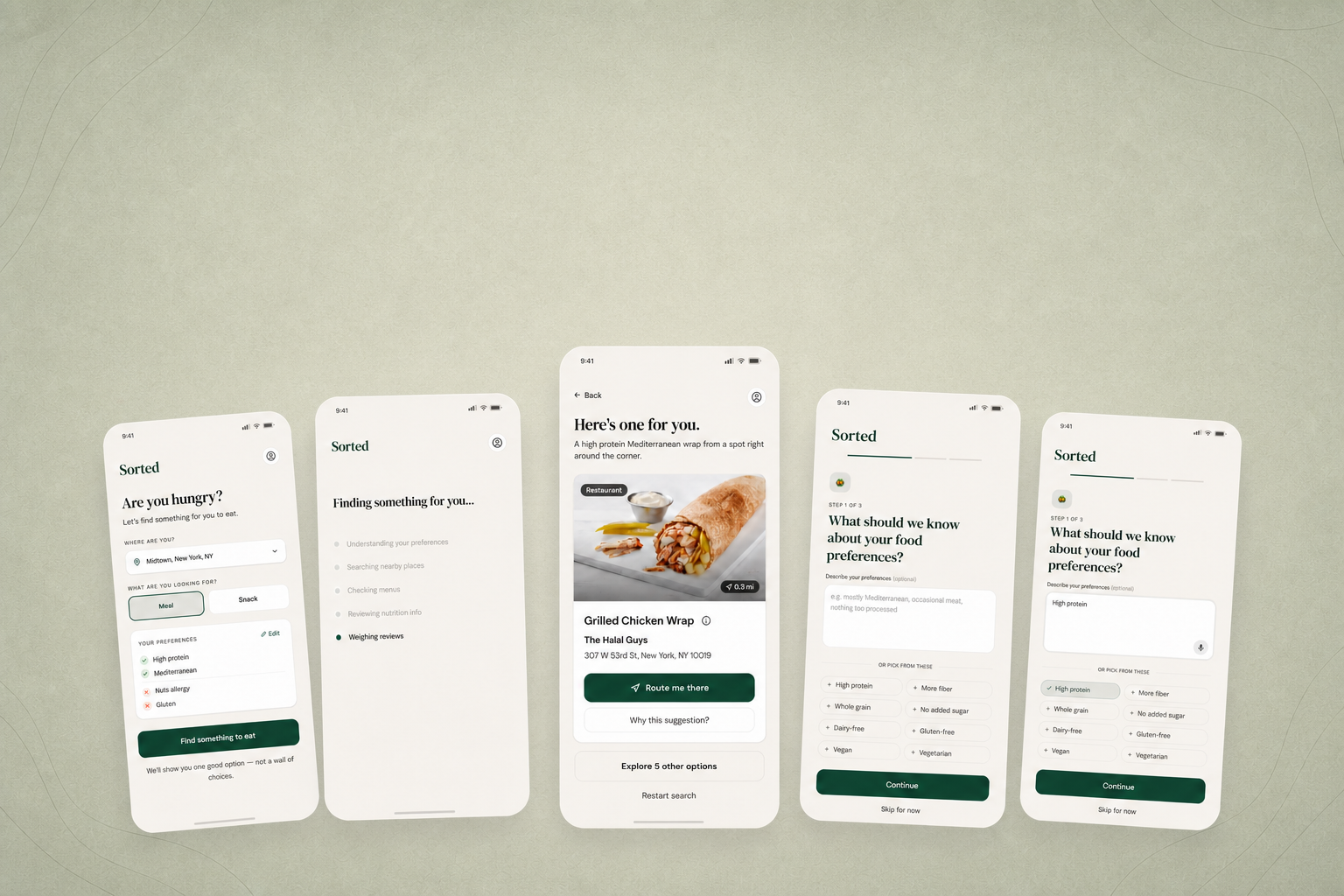
One tap surfaces a single nearby suggestion with a visible reason. Users can accept, browse further, filter, or get directions.
Open food search flowA quiet two-tap reaction, "worked for me" or "not for me." No ratings, no streaks, no visible score.
Open feedback flowAI's role: Claude generated the first draft of each flow and its interface copy. I used Figma Make to translate those drafts into interactive screens, then refined the experience against the research.
Where this project goes next
Extend guidance to grocery shopping and meal planning, while staying low-friction.
Usability test the single-suggestion model against browsing for actual food decisions.
Design fallback behavior for incomplete nutrition or restaurant data, so trust doesn't erode silently.
Set the context before prompting. A well-structured project with the brief, research, and guardrails produced much stronger results than relying on individual prompts.
Prompting is about constraints, not just instructions. I got better results when I defined what AI could use, what it couldn't assume, and how I wanted uncertainty handled.
Confidence isn't evidence. AI fabricated small but believable details and occasionally overstated findings. I learned to trace important claims back to their source before trusting them.
Labeling evidence changed how I made decisions. Using Validated, Partially Validated, Hypothesis, Assumption, and Recommendation helped prevent plausible ideas from quietly becoming facts.
Not everything needs to be resolved. AI is very good at making contradictions sound resolved. Sometimes the better choice was to surface the tension and acknowledge what still needed validation.
AI accelerated the work, but judgment stayed mine. It helped with synthesis, drafting, and pattern-spotting. Deciding what was credible, risky, or worth acting on remained my responsibility.